Meet the Gardener (Who’s Not Really a Gardener)…but made it onto the Homegrown National Park map anyway
I’m late for meetings because of butterflies.
Not because I’m irresponsible—but because once you start noticing what’s happening in your own backyard, you can’t look away. And because I read Doug Tallamy’s books.
I’m Samantha Bean, and I run Flutter By Meadows here in Hopewell Valley, New Jersey. I’m not a trained horticulturist. I’m not a master gardener. I’m just someone who got tired of looking out the window and seeing emptiness—and my husband and I decided to do something about it. I’m a wife, mom, homeowner and a nature writer.
What started as planting a few native plants in 2015 became something I never expected: a complete transformation of how I move through my days, what I notice, and what I’ve come to understand about creating habitat for wildlife in a suburban yard.
This is the story of how a 2.25-acre property went from turf lawn to living ecosystem—and what I’ve learned along the way.
How It Started: From Turf Lawn to Living Laboratory
In 2015, our yard was just grass. Standard suburban lawn. Mow it, edge it, repeat. We had a butterfly bush and a burning bush. They came with the house when we bought it. I was tired of looking out our windows and seeing nothing but grass.
So we started planting. A pollinator garden. A meadow in the one-acre detention basin that we got approval to retrofit from our township (we didn’t own the land on paper, be we are the only people that see it). A few native wildflowers and grasses. I didn’t know what would survive or how any of this would look. I did not know what an herbaceous vs a woody plant was. I was greener than the grass that April. I eventually had to write a whole post on Asclepias. Because was it butterfly weed? Or was it milkweed. What was I supposed to plant? And what the heck is the difference? I was confused, but excited.
I paid attention to my yard. Took some photos and some notes. And then something unexpected happened.
Nature Started Planting Itself
A bird planted a spicebush (Lindera benzoin). Another one planted an elderberry (Sambucus canadensis). An Eastern red cedar volunteered itself in the rain garden, and I didn’t have the heart to tell it it wasn’t welcome. Now there’s actually a trio.
At some point, I stopped trying to design a perfect garden and started paying attention to what wanted to be here. And something started to happen that Doug Tallamy said would happen on page 73 in Nature’s Best Hope: A New Approach to Conservation that Starts in Your Yard. He writes:
Close interactions with the wild animals in your yard can bring you the same emotional benefits that are gained from living with cats and dogs.
I began to notice birds like they part of our family. Red, the cardinal. Maude, the red-shouldered hawk. Peanut & Cashew my red-breasted nuthatch pair. Blue, the first blue jay that I truly thought knew his name.
That shift—to noticing—changed everything. And before long? I had a tea towel collection with bees and hummingbirds. I eat breakfast with binoculars. And I have a phone storage problem because I have more pictures of things with wings than I do of people. (More on that story in another post!)
What We’ve Done: Thinking in Layers
The single most important thing we’ve done to promote healthy wildlife habitat and be pollinator friendly on our property is to think about layers.
We didn’t just plant flowers under the garage windows. We created an ecosystem:
Canopy Layer
Native trees that offer early spring flowers for pollinators and structure for birds. Think oaks, maples, hop hornbeam, and serviceberry.
Shrub Layer
Berry-producing shrubs like elderberry, ink-berry holly, arrowwood viburnum, and native cedars that feed birds in fall and winter with juicy junipers.
Herbaceous Layer
Not just nectar plants for adult butterflies and bees—but host plants for caterpillars. Milkweed, spicebush, little bluestem grass, goldenrod, Joe-Pye weed.
Understory Layer
Ground covers and shade-loving natives under trees where lawn used to struggle. I have a new love, Pennsylvania sedge. This layer quietly protects catepillars too, so the birds have something to feed their young. What did Doug Tallamy say? Something like, “The squishier the better.”
Structural Elements
- Nest boxes for cavity-nesting birds like tree swallows, chickadees, and bluebirds (we have 8)
- Fresh water year-round: a small rock-lined basin and a bubbler in warmer months
- Leaf litter left in place as habitat for overwintering insects and ground-nesting bees
It’s not just one thing. It’s multiple small actions that compound over time.
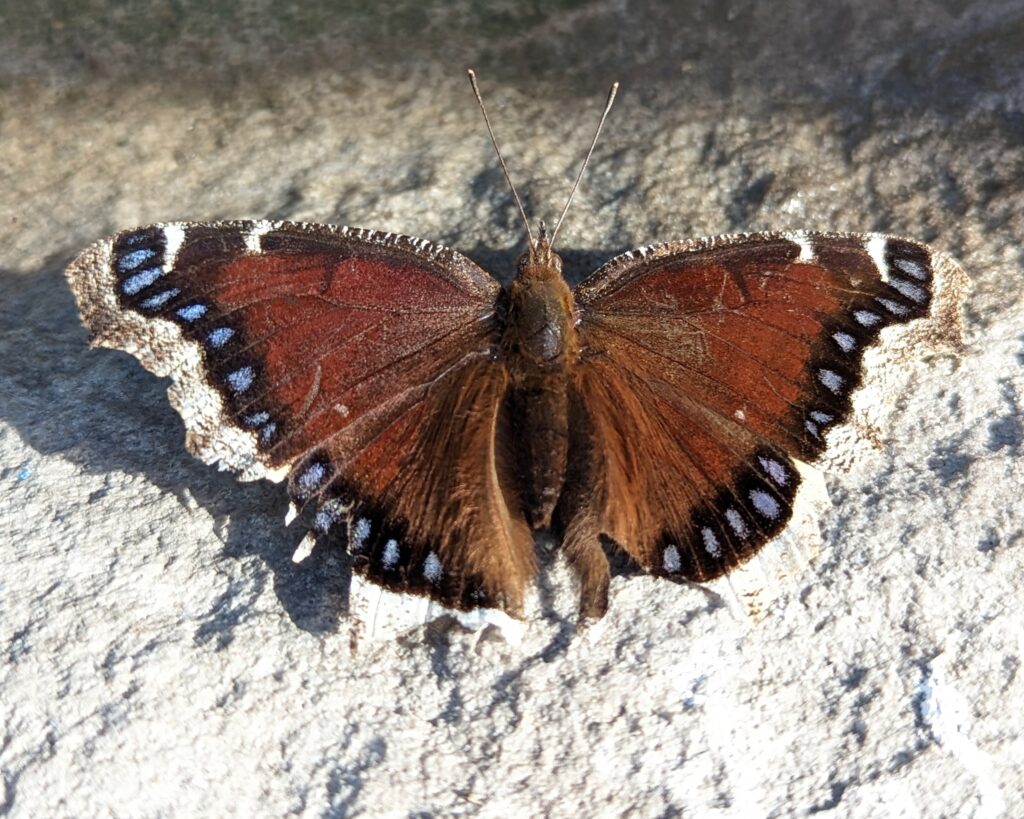
Not bagging the leaves. Letting volunteers grow. Adding water. Planting a “caterpillar” garden under a sycamore tree. Waiting to see what arrives. I saw a mourning cloak butterfly on April 1st this year. I was also almost late to the car line at school that day.
What I’ve Gained: A Different Way of Seeing
I often wonder if people hear “Flutter By Meadows” and think I sell meadows or landscaping services. I don’t sell anything. My blog and podcast exist for one purpose: to share the amazing events that happen year-round in my backyard, in my front yard, even in the sky above. I share the way I see things differently now, because native plants slowed my pace and brought back a sense of wonder. I found myself photographing moss in February. Why? Because up close? It’s magical!
It All Started With One Meadow
When we planted that meadow in the detention basin, everything changed in a single growing season. I was learning about migratory songbirds—warblers, tanagers, orioles passing through in spring and fall. I was learning what a host plant was—that monarchs need milkweed, that swallowtails need native golden alexanders.
I was learning what planning a garden for wildlife actually meant. And I wanted more and more of it.
If I could have that one songbird that I know now is what’s called a spark bird…what else had I been missing by being too busy to notice wildlife?
The Small Changes That Rippled Outward
We removed curtains and blinds from most of the windows in our home. I want to see what is out there. When I get the mail now, I take the long way—every time—to see what’s blooming, what’s arriving, what’s leaving.
We have two outdoor seating areas—one in the front yard, one in the back—because you never know which stage will be more active when you sit down to dinner.
I know that at 4:30pm in late spring, the tree swallows go bonkers in their aerial displays. I’ve been late for meetings because of butterflies. I’ve rescued a moth in my pajamas at 11pm.
What I’ve gained is a completely different way of moving through my day. Not because I’m more productive or organized—but because once you start noticing, you can’t look away.
My Advice: Start Small, But Show Up Consistently
If you’re thinking about planting native plants, creating habitat, or just bringing more life to your yard, here’s what I wish someone had told me: don’t let intimidating advice stop you. Many people in the native plant world speak in fancy words and Latin names. I was intimidated at first too. But I found my own way and let nature do the talking.
Plant Something. Then Watch What Happens.
Not just in year one. Keep watching. Notice who shows up. Notice the patterns. Notice what surprises you. Keep a journal.
This Isn’t About Perfecting Your Plant List
It’s about being present for what unfolds. Garden for discovery, not design.
You Don’t Need All the Answers
You don’t need all the Latin names. You don’t need a degree in horticulture or ecology. You just need one moment to stand still and notice. That’s where the shift begins. And once it does, it keeps growing—season after season.
The Stories Nature Tells Us
I wanted to share these discoveries with anyone who would read. And eventually, with anyone who would listen. That’s why I started The Flutter By Effect podcast and this blog. Because the stories that nature is telling us are everywhere—when you make the space for them to arrive.
The question is: will you stop and notice the show?
No responses yet